Overview Updated August 15, 2025: These days, a lot of people likely know what Fitbit trackers are. And if they’re not quite sure, chances are they have at least heard of Fitbit trackers, or heard them referenced by someone they know or someone around them.
But there’s a lot more to Fitbit and its catalog of trackers than the fact that a Fitbit is a wearable fitness tracking device. They have loads of features and can feel a little complex or overwhelming if someone just throws one in your lap and tells you to begin using it. You might not know how to use it. Or what it does. Or how to even connect it to your smartphone. You might not even know that you should connect it to your smartphone in the first place.
That’s what this guide aims to break down. What Fitbit is, and what it does, so you can be aware of everything it has to offer.
- What is Fitbit, and what are Fitbit trackers?
- How many trackers does Fitbit make?
- How much do Fitbit trackers cost?
- What sorts of features do Fitbit devices offer?
- What’s the Fitbit companion app?
- Where can I buy Fitbit trackers?
- Are Fitbit trackers waterproof?
- Are Fitbit devices customizable?
- How do I charge my Fitbit device?
- Can I use my Fitbit for mobile payments?
- Do Fitbit devices pose any health risks?
- Can I listen to music on it?
- How long will the battery last?
- Can Fitbit trackers be used to control smart home devices?
What is Fitbit, and what are Fitbit trackers?
Fitbit is the company that makes Fitbit trackers, and it’s been around since 2009 when the first device was launched. While it used to be its own independent company, Fitbit is now owned by Google. And you will start to see some of those Fitbit influences in some of Google’s own wearable and health-related devices and apps.
Fitbit trackers, on the other hand, are devices that you wear around your wrist. For the purposes of this post, we’ll include both the fitness trackers and the smartwatches that Fitbit makes in regards to what the devices can do. Unless otherwise stated and something is only available on a specific device. Because it does make both, and both will have an overlap in some of the features they offer to users.
In fact the majority of features Fitbit devices offer will be available on both types of devices and on most models.

How many trackers does Fitbit make?
This number will always vary because Fitbit is making new devices every year or every few years. But it’s also not necessarily making the same number of devices every single year. Another thing to consider is that when new devices come in, Fitbit will also sometimes get rid of older devices. It’s also important to note that since Fitbit is owned by Google now, Google is basically the one making the trackers.
Currently, Fitbit has four devices available. This includes the actual fitness trackers and a few smartwatches . The Fitbit devices you can currently buy from Google are the Fitbit Sense 2, the Fitbit Versa 4, the Fitbit Charge 6, and the Fitbit Inspire 3.
This list does not include older Fitbit devices, which you can still potentially buy from third-party retailers. There is bound to be some stock overflow, both from actual retailers and resellers on sites like eBay. Another thing that’s important to note is that the Fitbit Sense 2 and Fitbit Versa 4, the two Fitbit smartwatches, are no longer in production. Once Google runs out of stock, they’re gone. Fitbit smartwatches will also no longer be in production going forward. Smartwatches will continue to be part of the Pixel line, while trackers will remain under the Fitbit brand.
How much do Fitbit trackers cost?
The prices will also vary based on what features you want the tracker to have. The smartwatches that Fitbit offers are always going to be the most expensive. Because they have the most features, and some of their features are more advanced. They may also be made of more expensive materials.
That being said, Fitbit devices will range in price from $99.95 to $249.95. These are two normal prices for the Inspire 3 and the Sense 2. These are currently on sale for $79.95 and $199.95, respectively. Fitbit devices go on sale often, too. So, it’s worth keeping that in mind in case you’re interested in buying one either soon or further in the future.
A good time to buy a Fitbit device if your main concern is saving money is right before or right after a new device is announced. As Fitbit may have leftover stock of a device that’s being replaced and may want to get rid of it more easily by discounting the stock it has. Fitbit’s retail partners will do this as well from time to time.
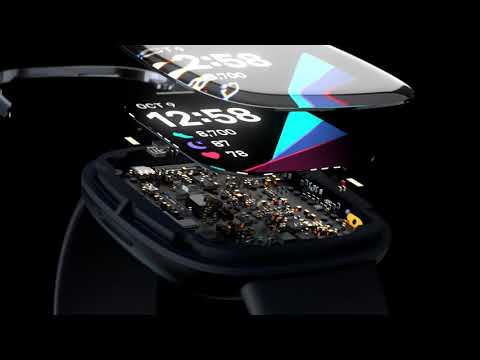
What sorts of features do Fitbit devices offer?
There are so many different features that it can honestly feel overwhelming at times. But the beauty of that is choice. There are a handful of choices of different trackers, so you can pick one that feels the best for your own personal needs.
You may want things like heart rate tracking, a color display, a swimproof design, and stress management. But you may not want a bigger display. So you’d go with something like the Charge 6 instead of the Sense 2. On the other hand, if you want the ECG app and sleep monitoring features, then the Sense 2 is the way to go.
Also worth noting is that the trackers themselves won’t hold all of the features. Fitbit’s companion app will house some of it. On the trackers, you’ll be able to track steps, heart rate, several different exercise modes, monitor sleep and stress, and much more.
On the smartwatches, you’ll get a few extras, like the bigger touch display, for example. The Sense 2 even has a compatible ECG app if you care to check in on that metric from time to time. There’s also support for Google Assistant and Alexa. Additionally, a 6+ day battery life on most of the trackers, and customizable clock faces, Active Zone Minutes, etc. Basically, there are a whole lot of features. So, you get the idea.
What’s the Fitbit companion app?
You’ll use this app to do a multitude of things. You need it to set up a connection with your smartphone, and you’ll generally use it for initiating updates to your device as well. Although you could also use the Fitbit Dashboard for computers to do the same things. The smartphone app is just more convenient since you can have it with you at all times.
The companion app will also show you all of your tracked metrics in one convenient place. Like a one-stop shop for your fitness data. And if you have a subscription to Fitbit Premium, then you’ll get even more features in the app. For example, access to all sorts of meditation and sleep sounds from the Calm app integration.
Not to mention personalized workout guidance, community engagement, and much more. Trust us, you’re definitely going to want to use the Fitbit app if you want to get the most out of your device.
Where can I buy Fitbit trackers?
You can buy them at tons of different retailers. Really, at just about any retailer that sells wearables. Fitbit is one of, if not the most popular, wearable brands on the planet. So, you’ll be hard-pressed to find a retailer that doesn’t have at least one or two of the different models for sale.
Keep in mind that how much the tracker costs will sometimes depend on where you get it. Whether you get it online or buy it in-store. And whether or not you’re buying a discontinued color (these don’t pop up often, but it has happened before).

Are Fitbit trackers waterproof?
None of them is really completely waterproof. They will, however, be swimproof up to 50 meters. Which means you can certainly take a dip in the pool with it. You could even wear it in the ocean, lake, or river as long as you’re not diving beyond the 50-meter deep limitation. This also means they’re perfectly fine in the rain, and you should have no issues with them being protected against sweat.
Because let’s face it, some of the time they’re going to interact with sweat if you’re using them as you should be. Which is during exercise. At the end of the day, don’t worry about damage from moisture unless you accidentally drop it in a body of water with a depth beyond 50 meters.
Are Fitbit devices customizable?
All Fitbit trackers will be customizable in one way or another. You’ll usually be able to buy most of the trackers in a few different colors. This will include the colors of the tracker itself as well as the strap or band. Some have even had special, limited-edition accessories in the past. However, there’s no telling if that will happen again going forward.
Unlike most smartwatches, though, Fitbit smartwatches (just like the trackers) cannot use any old strap. The straps have to come from Fitbit (now Google) or from a licensed partner who has created something for that particular device. And usually, your choices are more limited.
You can also customize the face or clock of your device. All of those customization options will be found in the Fitbit app.
How do I charge my Fitbit device?
Whatever tracker or watch you buy will come with its own USB charger. This is just the cable and the piece that attaches to the device, though. There is no AC adapter included. Which means you can either charge it by plugging the device into an open USB port on a desktop or laptop, or plug it into an AC adapter you already have.
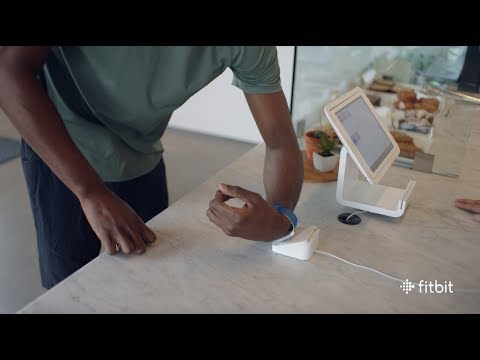
Can I use my Fitbit for mobile payments?
As a matter of fact, you can. You’ll need to have your Google Wallet and Google Pay account set up and your bank cards tied to it. But as long as that’s done, you can use Google Pay at any business that supports contactless payments. A lot of businesses support contactless payments these days, so it shouldn’t be hard for you to find somewhere that will let you use Google Pay through your Fitbit device. It’s as simple as that. That being said, you may want to check just in case, so you don’t leave your wallet behind and end up not being able to pay, or end up having to go somewhere else.
Do Fitbit devices pose any health risks?
You should not have to worry about Fitbit devices causing any health risks that you may be concerned about. However, while engaging in any physical activities while using your Fitbit device, it is possible for you to overwork yourself. This is, of course, not caused by the Fitbit but the activity itself.
Can I listen to music on it?
You can’t use the Fitbit device for listening to music on it. It does, however, work as a controller for music that you’re listening to. For example, devices like the Fitbit Sense 2 will have Spotify integration so you can pause, play, and skip tracks. The music itself would be streamed from your smartphone, which your Fitbit device would be connected to.
Unlike some Wear OS smartwatches, you also can’t store music on any current Fitbit devices while using connected Bluetooth headphones or earbuds for the audio. Which means you will still need your phone with you if you want to listen to music.
How long will the battery last?
The battery on most or all Fitbit devices will last you at least 4-5 days. Some may even last longer, depending on how you use it. If you have it constantly tracking your run routes with GPS, then the battery will die faster.
But more casual use, like checking your heart rate once or twice a day and checking the occasional step counter, or time, is bound to help it last closer to the 5+ day mark. Battery life will sometimes vary based on the device. But Fitbit has been pretty good about keeping this trait uniform across all its offerings. Officially, Fitbit devices are rated for about 7 days of battery life.

Can Fitbit trackers be used to control smart home devices?
If you have some in the home, then you can definitely use your tracker for that. As long as the one you have supports Alexa. All you would need to do is make sure that your voice assistant is set up on the tracker and that your smart home devices (bulbs, fans, etc.) are integrated with it as well.
Currently, only the Fitbit Sense 2 and Fitbit Versa 4 have support for digital assistants. For Alexa, you can use either of those devices. You also won’t need an Echo speaker of any kind to use the Fitbit trackers for smart home voice-control. Unfortunately, neither the Charge 6 nor the Inspire 3 supports voice assistants. That means you won’t be able to use these for controlling smart home devices.
