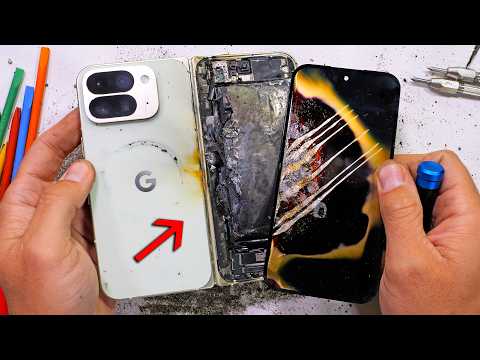
Just when you thought it was safe to bend your foldable phones without the battery exploding on you, the Pixel 10 Pro Fold goes and gets an exploded battery to throw you off. That’s along the lines of what happened to the Pixel 10 Pro Fold when JerryRigEverything over on YouTube put Google’s latest foldable through a bend test. During his durability test video of the device, the phone was bent backward to see how it held up to this kind of pressure and damage.
It didn’t hold up well, to say the least. If you were thinking that you could avoid this by simply not bending your phone in such a way, you might be right. However, there could be another underlying issue here that isn’t so noticeable. Any phone’s battery exploding should be treated as a potential major issue with an inherent risk of injury. Such as in this case.
The Pixel 10 Pro Fold was the first phone to end up with an exploded battery in these tests
The main thing to keep in mind here isn’t that this is an extreme test that caused the battery to explode. It’s that this is the first phone to have done this in the many years that JerryRigEverything has been testing the durability of phones. According to him, no other phone has had a battery explode during these tests. The Pixel 10 Pro Fold is the first phone to do this. Not even the Pixel 9 Pro Fold or the original Pixel Fold had this issue. So, that’s worth mentioning.
It’s not clear if there is some sort of underlying issue with the battery that may have contributed to this outcome. In any case, you can’t help but wonder if the battery could do the same thing in much less extreme situations. If it can, that’s a much bigger problem than the battery exploding from being bent in half twice.
The other problem is that some consumers will most certainly see this video and start to second-guess whether or not they should buy the Pixel 10 Pro Fold. After all, it’s not like Google’s latest foldable is the only foldable on the market. The Galaxy Z Fold 7 exists, and its battery didn’t explode during the durability test.
Foldable phones are cool, but let’s be honest: they still have an Achilles’ heel. It’s not the main hinge everyone worries about; it’s the microscopic stress points where components like the front camera or sensors hide. To put a hole in that layered, flexible screen, manufacturers introduce a tiny, invisible flaw—a prime spot for micro-cracks and moisture damage. However, it seems that Samsung is working on a self-healing tech for foldable displays that will keep sensors like the front camera and fingerprint safe.
This year the company boasted that its new Galaxy Z Fold 7 is more durable than ever. The Galaxy Z Flip 7 is also more rugged than previous generations. Now, A recently published Samsung patent reveals the company’s clever plan to address another problem inherent to foldable screens. This technology is essentially a built-in safety net that makes the screen an active participant in its own maintenance and defense.
Samsung’s patented self-repair display tech for foldable phones
Samsung designed a diagnostic system that embeds tiny wires—a “sensing loop”—right around the display cutouts. These ultra-thin wires, placed across different layers, continuously check the health of that delicate zone. In essence, the system can detect a microscopic crack or stress point the second it starts to form, long before you even realize anything is wrong.
Once those wires flag a flaw, the system fires off a unique defense protocol. It activates special “dummy metal patterns” near the damaged area. These patterns immediately kick in, reinforcing the weak spot and stopping the micro-crack from spreading any further into the vital display layers. This intelligent, rapid response is the core of the self-healing claim.

A win for durability and sensors
Samsung didn’t stop there. The patent (spotted by Summarize Meeting ) also details using specialized grooves and sealants around the openings. These barriers actively block external enemies like moisture and oxygen from attacking the sensitive OLED materials over time.
This complete package of sensing, instant reinforcement, and environmental sealing eliminates the single biggest risk associated with hiding sensors under a flexible screen. By fortifying these weak spots, Samsung removes the engineering hurdle that has plagued foldable phone design for years.
This patent essentially clears the way for a truly reliable, integrated in-display fingerprint sensor on future Galaxy Z models. It could finally allow Samsung to ditch the side button solution and make foldables feel truly finished. However, we are still talking about a patent, so there is no firm word on its commercial implementation yet.
